
Personal reminiscences

Czechmate: from Bohemian Paradise to American Haven

Dr. Rechcigl’s memoirs, in his own words — the books themselves, and the story of how the memoir was written, fought for, and finally published.

A memoir

Czechmate. From Bohemian Paradise to American Haven. A Personal Memoir

These reminiscences are an intimate account of Mila Rechcígl’s saga, his fascinating life, his varied and successful professional career, and his highly visible public life, encompassing some fifty years, since the earliest childhood in a small hamlet in northeastern rural Bohemia to his government career in the World’s Capital, Washington, DC, and spending his retirement years in active scholarship and voluntary work for non-profit organizations. He views his life as a chess game, in which he confronts various challenges head-on, usually ending with a “checkmate” in his favor.

Publisher
AuthorHouse, Bloomington, IN
Year
2011
Extent
771 pages

The opening of the memoir — Foreword, Preface and Prologue — is reproduced below. The complete memoir is posted by the author on Academia.edu.

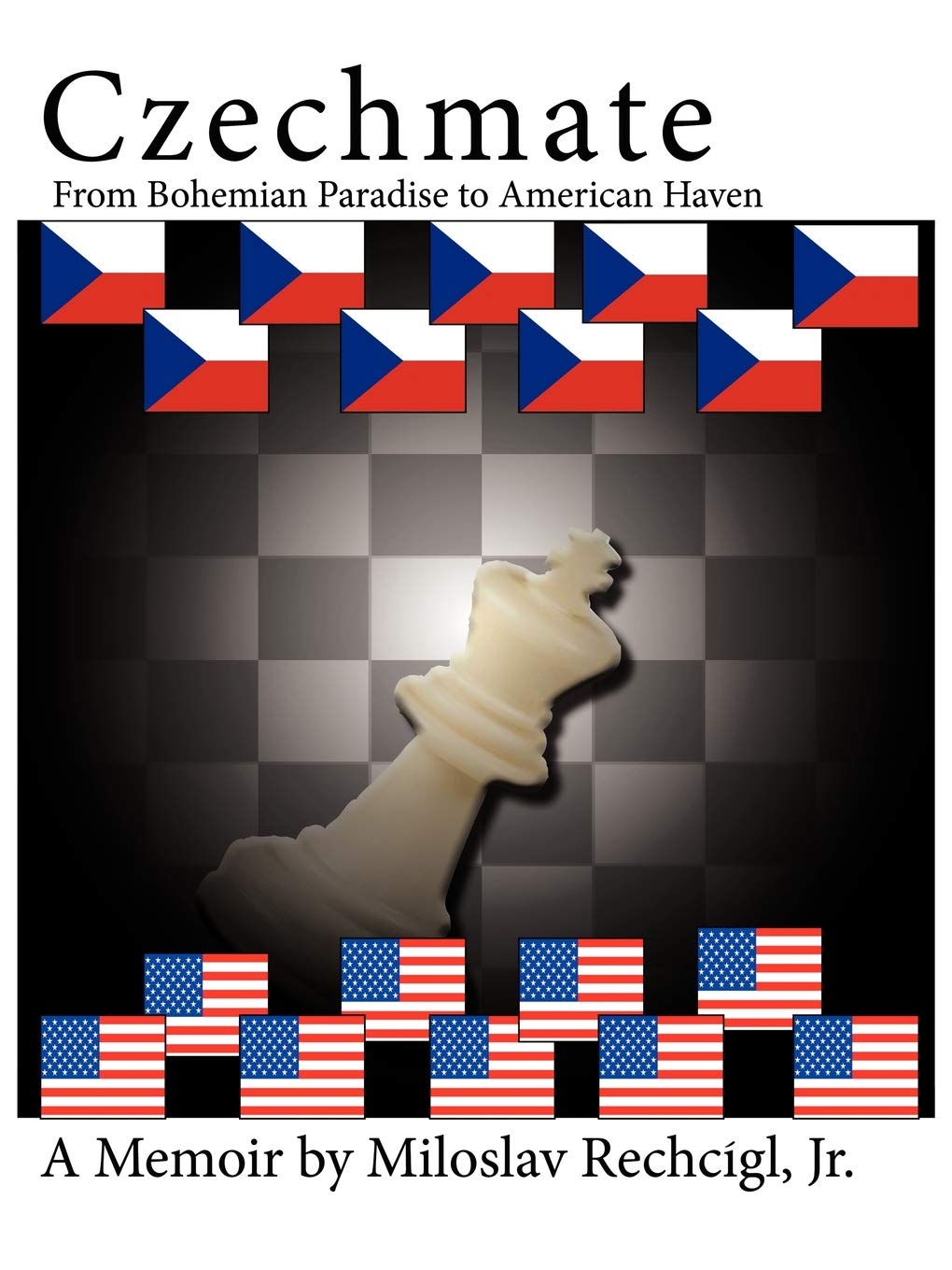
Cover of Czechmate: From Bohemian Paradise to American Haven, A Memoir by Miloslav Rechcigl, Jr.
The author-supplied cover.

From the original manuscript

Foreword, Preface, and Prologue

Foreword

One of my greatest pleasures and honors while serving as the Czech Ambassador to the United States of America was to meet and to get to know many members of the Czech community living in the United States. Many of them decided or were forced to leave their home country after Czechoslovakia was subjugated by the communist dictatorship. They couldn’t live in an oppressed country, in a regime that denied rights and freedoms to their citizens.

Many members of the Czech- and Czechoslovak-American community not only found their second home in the United States: they also worked extremely hard to preserve, develop and spread Czech and Slovak heritage in America and in the world. I am convinced that these efforts, by which they made the American public and the world at large aware of our culture and our traditions, also played an incredibly important part in helping the political goal of liberation of Czechoslovakia and the return of freedom, democracy and independence to our nations.

One of the finest examples of such members of the Czech-American family is Miloslav (Míla to me) Rechcigl, Jr. From the first time we met in 1991, I have admired his energy, his dedication, and his love for both his old as well as new home country. As a scientist, organizer and researcher, he devoted his life to the Czechoslovak Society for Arts and Sciences (SVU), in a strong belief that it is through arts and sciences that the spirit and soul of a nation perseveres and endures. And he was right. Míla’s whole life is a testament to the success of his credo. His personal story inspires, and his memoirs thrill—with so many stories of life lived to the fullest, and in service to the ideals that the original Czechoslovakia shared with the founding principles of the United States.

I am proud to have met Míla, I am honored to be his friend, and I am glad that he decided to share his personal story with us, his readers.

— Petr Kolář, Czech Ambassador to the United States

Preface

When I started working on the genealogy of our family, my children commented that names and dates and complex family linkages by themselves have little meaning, unless I add a personal touch and include also some information on how we lived and what ‘made us tick.’ They pointed out the example of my father-in-law, Dr. Paul J. Edwards, who, toward the end of his life, began writing his witty memoirs but died before he could finish it. When, five years after they were published, my sister-in-law Helen Steiner and my brother-in-law Frank Steiner wrote their personal reminiscences, I decided that I would attempt to do the same.

I never intended to write my personal memoirs which I always have considered to be the domain of politicians and important public servants or literary and artistic figures. As a scientist, I was trained to keep my nose to the grindstone, i.e., to focus on writing scientific and technical papers. To my knowledge, very few scientists had written their memoirs, unless they were Nobel Prize winners. My first attempt toward non-technical writing had its start around the time I retired, when I began publishing a series of newspaper articles and essays about the life of notable Czechs in the US.

Had I known that I would, one day, write reminiscences about my life I would have certainly kept a detailed diary. Fortunately, among my father’s possessions I found old letters which my wife Eva and I exchanged with him, almost regularly from 1949 until 1972. Dad wanted constantly to be informed about how and what we were doing and these letters contain a wealth of information and particularly names and dates which I have long forgotten. In addition, we also found some correspondence with Eva’s parents. I found it useful to quote passages from them, because it added authenticity to specific events and, moreover, they accurately portrayed our feelings at any particular time. Many of these letters were Eva’s so that these Memoirs are equally hers as they are mine. Except for minor stylistic changes or punctuation, I left the original text from the quoted letters intact. My correspondence with Dad, which was in Czech, had to be translated.

I had no such resource material for the period preceding my coming to exile, and consequently the narrative is based on my memory or ‘imagination.’ The events that occurred in the last thirty years, or so, were still fairly clear and vivid in my mind and, if in doubt, I was able to check on the specifics with my contemporaries. After I retired, I began regularly to keep notes.

I began working on the memoirs in October 1998, while spending a few days at our condo in Ocean City. The weather was rather dreary, as it was raining most of the time and I had little to do. So I began putting together a draft outline of the milestones in my life which became the basis for these memoirs. I then started writing individual chapters, whenever I had some time, not in any particular order, but rather what I felt like writing at that particular moment. During some months I did not do any writing at all. As I went along, my original outline had to be, of course, continuously modified. By 2005, the bulk of the Memoirs was finished, with some gaps remaining in between the chapters. I gradually filled in the gaps and then kept updating my Memoirs so that they were current.

Before beginning the narration of my life I thought it appropriate to first provide a background as to the place and the times I was born into. The geographical and historic setting of my birthplace with its cultural milieu and historic traditions that transcend a millennium had a profound impact on my development and thinking. It is for these reasons that I have devoted the first few chapters to these matters.

The Memoirs are arranged more or less chronologically, covering my formative years, the adulthood, the prime of life and the years after retirement. Through 1968, my private life was so much interwoven with my career so it made sense to discuss them together. After I became an administrator, my interests and activities widened considerably. I therefore decided to discuss each aspect separately. I actually lived three or four separate lives in those days, i.e., my private life, my professional career, life as a writer and editor, and finally as a volunteer in professional organizations, particularly in the Czechoslovak Society of Arts and Sciences (SVU). My long association with and my activities in the latter were written in my personal memoir, published separately in 2008 on the occasion of the 50th anniversary of the Society.

I have tried to put individual events into some context and, whenever applicable, provided documentation by citations from literature and/or by adding explanatory footnotes. For easier use and better orientation, the publication is appended with the chronology of events, and a name index. The Memoirs end in 2006, the year in which I also retired from SVU as its President.

Some readers may wonder about the title of this book, while others may even accuse me of not knowing how to spell. The latter may be correct to a degree, to be sure, but let me assure you I have chosen the title, which is of my invention, quite deliberately. I am obviously playing on words, as Tom Stoppard would say. As some of you may have guessed, the ‘Czechmate’ relates to the word ‘Checkmate,’ to which I added the Czech flavor. Although I am not a chess player, I know what the word means. Just as in a chess game, I had to frequently face challenges that had to be confronted head on. Fortunately, with perseverance, I won most of such battles, frequently against all odds. That is why I have chosen ‘Czechmate’ for the title.

Prologue

In viewing my life, in retrospect, I feel I have lived it to the fullest and have no regrets whatsoever for any of its facets. The times that I spent under the Nazis and the Communists, rather than weakening me, made me actually stronger and ready for the many challenges that awaited me after immigrating to the United States.

Nothing was ever served to me on a silver platter and whatever I have achieved I had to fight for. I always welcomed new challenges and, interestingly, I seemed to do best as an ‘underdog’ when I had to prove myself and show that I was ready for the task and eventually came on the top.

I am extremely grateful to my beloved adopted country, the United States of America, for the unlimited opportunities it has given me, which have enabled me to reach my ‘horizon.’ Had I chosen another line or path, whether in business or politics, or any other profession, I am sure I would have succeeded just as much because all the ingredients and all the opportunities are here. It takes only one’s will and determination to attain one’s goals and aspirations. If you believe in yourself, you can accomplish almost anything in this country. There is no obstacle that one could not overcome.

I have never allowed any of my disappointments to let me down. Actually I have always learned from them and used such occasions for turning my life around—for the better. My experiences have also taught me to avoid unnecessary conflicts, while not shying away from confrontations when a matter of principle was in question. I have always adhered to Masaryk’s motto, ‘Truth prevails,’ and implicitly believe that a good cause must eventually override the bad, irrespective of how great the obstacles or strong the opposition may be.

Even though I have spent more than three-fourths of my life in the US, I have never forgotten the country of my origin. Czechoslovakia—the country of my birth—will forever stay in my heart and I will always cherish the precious moments and memories of my formative years and treasure and retain in my soul the historic traditions with which I have grown up and that have molded my mind and my spirit.
In the author’s words

Publishing my personal memoirs

The story behind the publication of his memoir Czechmate: From Bohemian Paradise to American Haven, from the manuscript of its sequel.

Listen

Sample reading — the essay’s opening

After publishing my monograph On Behalf of their Homeland: Fifty Years of SVU, it was only natural that I began thinking about putting in print also my personal reminiscences, which had almost been completed. I did not do much about it until the beginning of the year 2010, when I approached the SVU Publication Committee, inquiring whether the Society would be interested in sponsoring it, as they did in the case of the referenced monograph through East European Monograph Series and Columbia University Press.

It was two months later, when I heard from SVU President Karel Raška, who told me that everybody on the Board enthusiastically supports the idea and on March 24 he called me, inquiring about the status of my manuscript, advising me “to discuss the publishing details with Fischer-Galati directly and tell him to send the bill.” Stephen Fischer-Galati, whom I knew personally, was in charge of the East European Monograph Series. Raška also mentioned that Fischer-Galati assured him of having my book published in a matter of three months, if I would send them a camera-ready manuscript. Actually, I had already been in touch with his daughter regarding the format and pagination. My manuscript was, otherwise, more or less finished, except for a foreword, dedication and illustrations.

Once I received the specifications from Nancy Fischer, I got in touch with my friend Jiří Eichler, who was then living in Paris, who agreed to format my manuscript and also paginate it. By then I had picked Checkmate for the title, with From Bohemian Paradise to American Haven, as a subtitle. The title, I had chosen, was based on the fact that I viewed my entire life as a chess game, frequently being challenged by all sorts of problems which I confronted head on, and, fortunately, usually succeeding with a ‘checkmate,’ which I symbolically changed to Czechmate, to signify my Czech ancestry.

While we were on our vacation in Florida, our granddaughter Kristin created a fitting picture for the cover, consisting of a chess board with the King in lying position and the Czech and American flags on each side. It looked very attractive. Since my chapters were saved as individual files, Jiří Eichler had to first combine them into one file, before any formatting or pagination could be undertaken. Following the instructions from Nancy Fischer, I had to also increase resolution of all my pictures to meet the dpi specifications of the publisher.

Then, for some unknown reason to me, I had not heard from Nancy Fischer for almost a month and did not even get acknowledgment from her that she received my manuscript, which I sent her in record time. I finally called her and heard from her husband that she had just come home from the hospital after an operation. It was on April 19, when she, for the first time, acknowledged the receipt of my manuscript, with the comment that she briefly looked it over and that I did a very good job. She promised to be back in touch when she looked it over in more detail.

Then more silence, until I finally succeeded in getting Nancy on the phone. To my dismay, she told me that they cannot possibly finish the book this year and that it will have to wait until next year — possibly March 2011! I almost had a stroke. I immediately called Raška on the phone, who got in touch with Fischer-Galati, who again assured him not to worry and that my book would be out in the three-month period, as he promised. I then exchanged several e-mails with Nancy Fischer, who promised to get back to my manuscript and start preparing the INDEX. Then silence again and, in spite of my numerous e-mails and Raška’s efforts to talk to Fischer-Galati, we did not hear anything before our departure for the Czech Republic on June 25.

Upon our return to the US, a shock was awaiting me in form of Fischer-Galati’s letter, nonchalantly, informing me that they decided against publishing my manuscript, presumably because they were going out of business, suggesting that we get in touch with Sheridan Press whom he used in the past as printer. I did, finally, also hear from Nancy Fischer who said she would be willing to format my manuscript and prepare the INDEX for $2,000 (which was half of what she normally charged others, she said), with the understanding that we would find ourselves a suitable printing company which would print the book for us.

When I contacted Sheridan Press, which Fischer Galati recommended, they wrote me that they might consider printing it if we would order at least 250 copies of my book. This sounded very expensive, in addition to being rather ‘iffy,’ particularly when they refused to tell me how much they would charge us for a single copy. Without further ado, I engrossed myself in busy e-mailing, in the search of another suitable publisher. I must have contacted at least a dozen possible firms, including so called publishers on-demand who publish a limited number of copies first, and depending on how the book would sell, they would then print additional copies.

I had an enthusiastic response from Dorrance Co., which, after reviewing my manuscript, wrote that they were ready to publish it. This sounded great until I later found out that I would have to pay them first some $30,000, just for printing and marketing, without even mentioning whether or not they would give us any free copies of the book.

It was on July 20th when I contacted James Fuller, Publishing Consultant with the AuthorHouse Co., who expressed interest in having my book published, if we would buy one of their publishing packages. In my rough calculations, I thought that the cost would not exceed $2,000 for all the work and we would even get a number of copies free. This sounded quite reasonable to me, compared to what Nancy was offering us or what the Society had to pay for books published in the East European Monograph Series. I immediately informed Raška about it, who thought this was a great deal and that I should go ahead with it.

So after several e-mail exchanges with James M. Fuller, he switched me to Adam Young, Senior Publishing Consultant with AuthorHouse who sent me the Payment Agreement for my approval. I chose the ‘Pinnacle’ publishing package which included all sorts of publishing package services, this being the most comprehensive publishing program offered by AuthorHouse. The ‘Pinnacle’ publishing package also included a number of paperback books and hardcover books to jumpstart our personal sales. The ‘Pinnacle’ publishing package was presumably the best value, priced around $2,000, which I thought I would be able to negotiate down.

I was then assigned Ryann Jacoby as my Check-In-Coordinator (CIC), whose job it was to help me get the manuscript ready for publishing. She sent me rather elaborate subscription information which took me a while to fully digest. According to their specifications, my manuscript was, unfortunately, far too long, having approached almost 1000 pages, if the pictures were also included. They offered me two possible formats. Their 5 x 8 and 6 x 9 books could have up to 740 pages, compared to 8 ¼ x 11 books that could have 828 pages. In my case, only the latter applied. This gave me quite a bit of concern since I did not want to start cutting out chapters which took me so much time to put together.

This prompted me to call Adam Young to explain it to me and to help me go through the painful process. Adam advised me to cut out blank pages and the section on chronology and let him know the resulting number of pages. I followed his suggestions and in doing so I must have eliminated over 50 pages. In a number of instances, I also combined paragraphs and cut out some words whenever there were only a few lines on the page. It took me several days of steady work. This however still did not get me out of the woods, since my total number of text pages was 861 plus 15 pages of front matter. With eliminating spaces between individual chapters, I was able then to cut down quite a few additional pages to the point that I felt I was within their allowed limits. But in spite of that, I was told to cut out additional fifty pages; as a consequence, I was forced to remove one entire section from my manuscript.

By then, I was also able to send my illustrations with the desired resolution to Ryann Jacoby. Besides the manuscript, I also sent them Index terms which I selected and which they promised to paginate for me, so that I could then beef them up and augment them with additional entries, in preparation of the final Index. They misconstrued this somehow and only after I sent them numerous e-mails, they started to work on it which delayed the whole process considerably.

Subsequently, I was put in contact with Sara Kelly, of the Timber Team, responsible for the design of the book. This new group of people was somehow assuming that I opted for the smaller format, which was not true, since at the very beginning I ordered the larger format in order to fit in more pages. When they finally switched me to a larger format, to my dismay, I was told that I won’t get any hard cover books, which I thought were part of the package I ordered. On the other hand, it turned out that, with a larger format, I was actually entitled to have more pages and could have easily kept the section I removed previously. But it was too late. This, of course, led to further delay, since all these things did not get sorted out until I reached the higher echelon of the management, when, for some reason, the staff stopped responding to my e-mails.

Making a long story short, I was told that I would get my galley proofs by Christmas and anxiously waited for it, while visiting with Karen in Florida, but the galleys did not come. It was not until we returned to Maryland, when the proofs finally arrived, on January 10. In general, the proofs looked very good, with only a few minor mistakes, however, the paginated Index terms were full of errors, and they wanted to charge me $100 for every block of 25 modifications. Inasmuch as I was planning to incorporate additional entries, this would run into hundreds of dollars. It took a while to straighten out the apparent misunderstanding, for which I had to reach again the higher management for assistance. They agreed to start from scratch, and I would make my own new Index.

Once this was resolved, I was beginning to see the green-light at the end of the tunnel. I had every hope that from this point onward it would be smooth sailing. There were still some problems with the image Kristin created for my cover. Apparently, it was only 4.55 x 5.65 inches at 300 dpi. According to AuthorHouse requirements, the image must be 8.5 x 11.25 inches and have a resolution of at least 300 dpi. I immediately informed Kristin and Karen about it who wrote back that, with the help of their friend who used to be in publishing business before, they would be able to modify the picture according to the publisher’s specifications.

By February 4, I had my new Index, on which I worked two full weeks, completed. After I sent it to Sara Kelly, she responded “The new index looks fabulous. Thank you for all your hard work!” By that time, she also sent me the galley of the new cover image Kristin prepared. It looked fine at first glance but later I discovered a bad mistake, i.e., that one of the Czech flags was upside down which had to be corrected. Within a week they were able to correct this final obstacle.

On March 17, 2011, AuthorHouse sent me the first printed copy of my book for inspection. It looked great which prompted me to send them the following note of appreciation next day:

Dear Friends: Yesterday the first copy of my book – Czechmate. From Bohemian Paradise to American Haven - arrived. Frankly, I was quite impressed when I saw it. I want to thank you all, for all the effort and hard labor you put into this project, including tolerating my old man’s idiosyncrasies. You have all done a wonderful job! The AuthorHouse can be proud of this accomplishment. I haven’t seen any problems with the book copy you sent me so that “your presses can start rolling.” Thanks again for all your help. Sincerely, Mila Rechcigl

Once I received more copies, I distributed them among my relatives. Most of them went first to the Index, which was quite voluminous, to see what I had written about them.

Eva’s sister Helen, after reading a few chapters, sent me the following note:

I have been reading your book and since I am interested mainly in the personal life, I have enjoyed your Cornell and early Washington years. How fortunate that Eva wrote often and such very good letters to your father and he kept them all. I was surprised how well he wrote in English, I only communicated with him in Czech, the few times I saw him. I also was amused in his letter when he found out Eva was pregnant and he assumed it would be a girl so that she could help Eva, and if the second child were a boy, the girl could help with the baby boy. I also did not realize that most of the time at Cornell you were entertaining at parties, playing volleyball and tennis and being entertained by your many friends. I must admit I skipped over your pigs, hamsters, lemmings, rats and amino acids. Your book is very impressive, and your index is awesome! Congratulations!

— Miloslav Rechcigl, Jr.

And then

A Sequel to Czechmate. A Personal Memoir II

This is a sequel to Mila Rechcigl’s personal memoir, Czechmate: From Bohemian Paradise to American Haven, which viewed his personal and professional life as a chess game in which serious challenges were confronted head-on and obstacles overcome by a true ‘checkmate.’ Now retired for a number of years and having entered a new career as a non-fiction author, he asks whether and when he will be ‘over the hill.’ Since then he has published eleven monographs, including the three-volume, 2,538-page Encyclopedia of Bohemian and Czech-American Biography, as well as three Czech-language reference books. Apart from a retrospective look at his work and activities and some unforgettable characters he met, the memoir offers glimpses of Czechoslovak exile life and his perceptions of leading Czech and Slovak personalities abroad and in the old country.

The essay above, “Publishing my personal memoirs,” is drawn from the opening of this sequel.

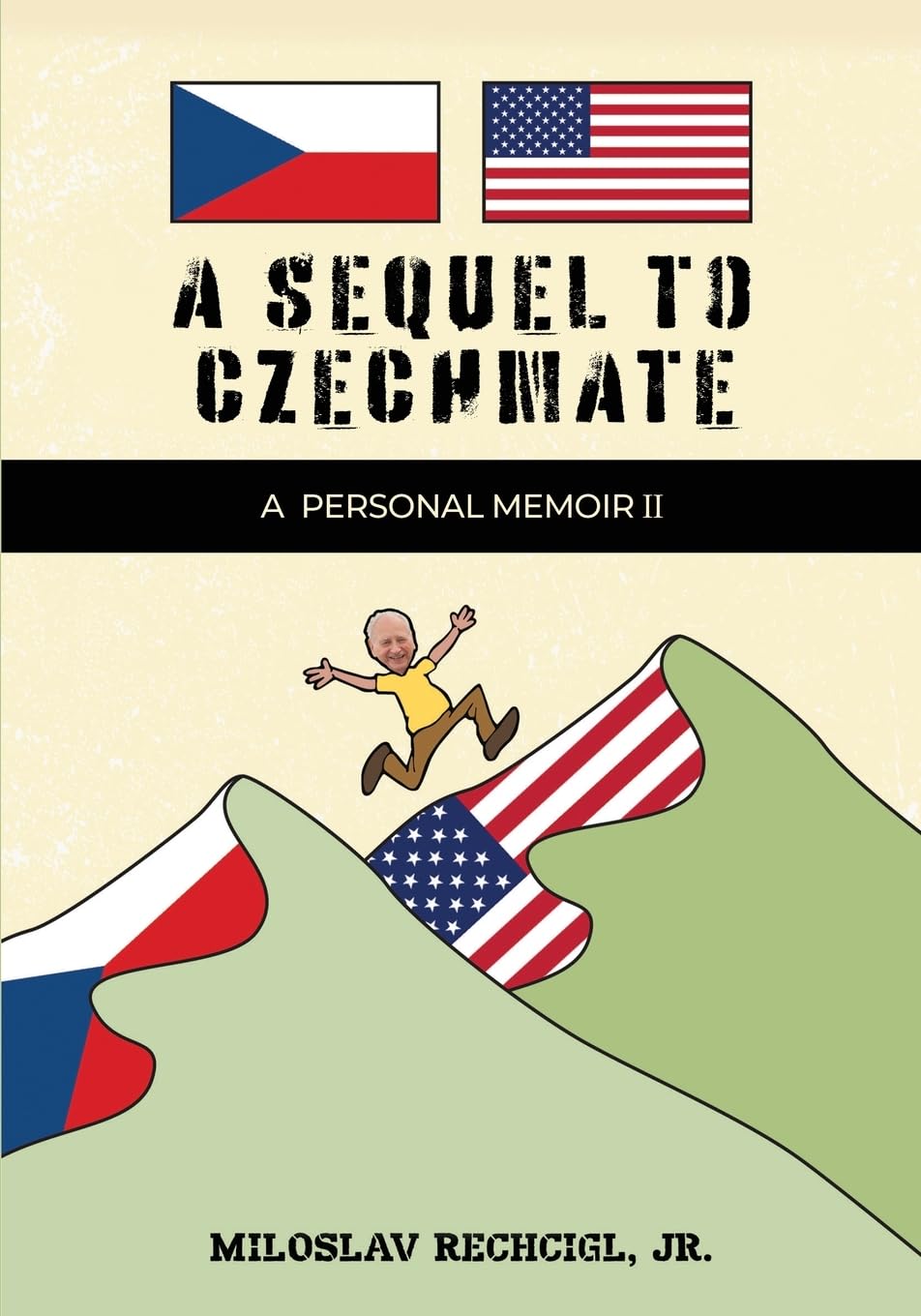
Cover of A Sequel to Czechmate: A Personal Memoir II
The author-supplied cover.
Publisher
Author’s Tranquility Press, Atlanta, GA
Year
2024
Extent
1128 pages