
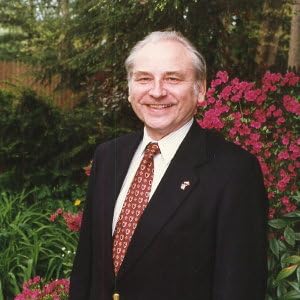
The Scientific Administrator & Biochemist
Born in Mladá Boleslav, Czechoslovakia, on 30 July 1930, the son of Marie and Miloslav Rechcígl — a miller and farmer from Chocnějovice who became the youngest deputy elected to the Czechoslovak Parliament during the First Republic. He spent the war years under Nazi occupation and, after the Communist coup d’état, escaped to the West, immigrating to the United States in 1950.
On a scholarship he went to Cornell University, where he studied from 1951 to 1958, receiving his B.S., M.N.S., and Ph.D. degrees there, specializing in biochemistry, nutrition, physiology, and food science.
He then spent two years at the National Institutes of Health as a postdoctoral research fellow, and was subsequently appointed to the staff of the Laboratory of Biochemistry at the National Cancer Institute, where for some ten years he conducted extensive research on cancer biochemistry and enzyme turnover in vivo. He specialized in amino acids, cancer biochemistry, and the enzyme catalase, and considers his greatest scientific contribution to be research into the kinetics of enzyme synthesis and degradation under varying physiological and pathological conditions.
During 1968–69 he was selected for one year of training in a special USPHS executive program in research management, grants administration, and science policy. This led to his appointment as Special Assistant for Nutrition and Health in the Health Services and Mental Health Administration. In 1970 he joined the Agency for International Development, US Department of State, as Nutrition Advisor, soon promoted to Chief of the Research and Institutional Grants Division and later Director, with responsibility for reviewing, administering, and managing AID research. In that capacity he regularly visited the countries where the Agency funded research, from Thailand to Guatemala.
He is the author or editor of over thirty books and handbooks in biochemistry, physiology, nutrition, food science and technology, agriculture, and international development, in addition to a large number of peer-reviewed scientific articles and book chapters.